Comparison

Utter vs Trello.
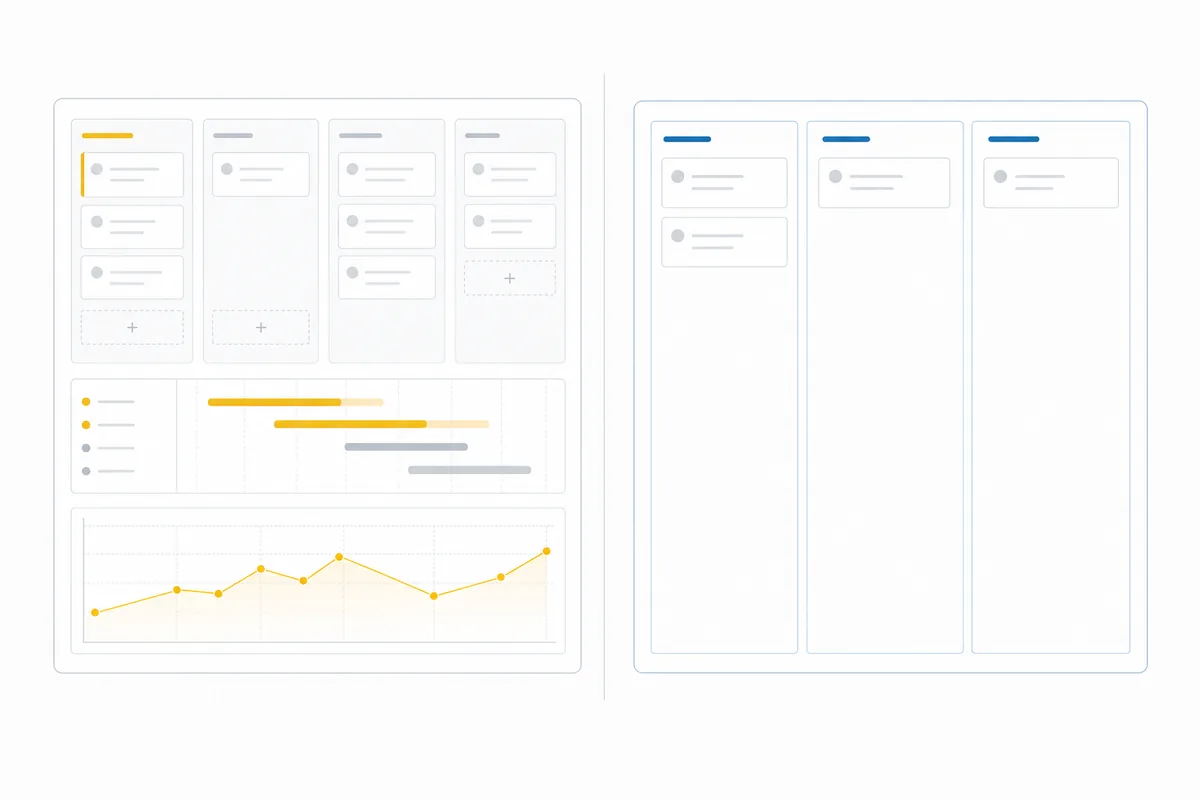
Trello is the easiest project tool ever made, and for a simple shared board it is still the right answer. Utter is for the day the board stops being enough: sprints, backlog, reports, docs, and AI agents, without giving up the calm.
Last updated: 15 Jul 2026

The short version.
Pick Utter if
- You have outgrown cards: you need a backlog, sprints, estimates, reports, and issue keys people can reference in commits.
- You want docs next to the work instead of buying Confluence separately.
- You want AI coding agents working as named members with live sessions on the ticket.
- Your free plan needs more room than 10 collaborators and 10 boards.
Stick with Trello if
- A simple visual board genuinely covers your workflow; nothing beats Trello's learning curve.
- Your process depends on specific Power-Ups you already trust.
- You are a small group tracking lightweight lists, not shipping software against deadlines.
Feature by feature.
| Feature |  |  Trello Trello |
|---|---|---|
| Price, standard tier | $3 per builder / month. Viewers free, no cap | $5 per user / month (Standard) |
| Tier with timeline and AI | Everything ships on every plan | Premium, $10 per user / month |
| Free plan | Unlimited members, 5 projects | 10 collaborators, 10 boards per workspace |
| Free read access | Viewers free, unlimited, on every plan | Single-board guests free; multi-board guests billed as members |
| Backlog, sprints, velocity | Native | Not native; assembled from lists and Power-Ups |
| Timeline / Gantt | Built in, with dependencies | Premium tier |
| Reports | Velocity, burndown, cumulative flow, workload | Minimal; needs Power-Ups |
| Docs and wiki | Built in | None; Confluence is a separate product |
| Automations | 2 free, 20 Pro, unlimited Business | Butler: 250 runs / month free, more on paid tiers |
| Named AI agents as members | Yes, with their own profile and attribution, never billed as seats | No; AI features on Premium |
| MCP server | Yes, first-party, covers the full API | Yes, first-party (Atlassian), read/write/search, one workspace per connection |
| Trial | 14 days of Pro on your first workspace, no card | 14 days of Premium, no card |
Rival prices and limits are public list prices as of July 2026. Check trello.com/pricing for current numbers.
What a real team pays.
Trello is cheap per seat, and honestly so. The cost shows up in what is missing: reports, sprints, docs, and dependencies live in Power-Ups, Premium, or a second Atlassian product, and everyone who follows more than one board becomes a billed member.
Team of 6 builders and 15 followers, per month
- Trello Standard: 21 members x $5 = $105 (multi-board followers are billed)
- Utter Pro: 6 builders x $3 = $18, viewers free
If you need Trello's timeline view and AI features, that is Premium at $10, and the same team is $210. Trello's single-board guests are free, which works for client-facing boards; it is the internal audience that gets expensive.
Where Trello is genuinely strong.
Zero learning curve
Nobody has ever needed training to use Trello. For groups where adoption is the whole battle, that simplicity is worth more than any feature list.
The Power-Ups ecosystem
Years of integrations and board extensions mean a bolt-on exists for almost anything, from CRM-ish fields to calendars.
Honest low pricing
$5 for Standard is the cheapest paid tier among the well-known tools, and the free plan is fine for a small personal or family board.
Where Utter is different.
A tracker, not just a board
Issues have types, keys, estimates, and workflows. Backlog, sprints, velocity, burndown, timeline with dependencies, and custom fields are native, the things teams bolt onto Trello until it stops being simple.
Docs included
Specs, notes, and a knowledge base live in the same workspace as the work. Trello's answer is Confluence, a separate product with its own bill.
Agents are teammates, not scripts
Connect Claude Code, Codex, Cursor, or any MCP client as a named agent. Assign it issues, watch its session run on the ticket, and see every change attributed in the activity log.
Built for English and Arabic
Full right-to-left layout, Arabic templates, and a Hijri-aware date layer. Not a translation pass, a first-class locale.
Common questions.
Can I import my Trello boards?
Yes, directly. Utter's Trello importer maps boards, lists, and cards to projects, statuses, and issues, with assignees and comments. Free workspaces import up to 1,000 rows per run, Pro 10,000, Business 50,000.
We like Trello's simplicity. Is Utter going to feel heavy?
It is designed not to. The board is still the center, and features like sprints, custom fields, and workflow rules stay out of the way until you turn them on. The difference is they exist when you need them, instead of arriving as a pile of Power-Ups.
When do teams actually outgrow Trello?
The usual signs: someone maintains a spreadsheet next to the board for estimates or reporting, cards carry bracketed prefixes pretending to be issue keys, the same work exists on three boards, and nobody can say what shipped last sprint. Any one of those is the moment.
Trello has an MCP server now too. What is different?
Yes, Atlassian shipped one for Trello, with read, write, and search scopes, one workspace per connection. The difference on Utter is what the agent is: a named member with assigned issues, live session states on the ticket, and full-API access, not a connector to cards.
What does Utter not have that Trello has?
The Power-Ups marketplace and Trello's years of third-party board extensions. If your workflow depends on a specific Power-Up, check the equivalent exists in Utter (automations, webhooks, API) before moving.
Try the whole thing free.
Every new team gets 14 days of Pro on their first workspace, no card. Import a board, run one sprint, and see what the upgrade feels like.