
Will AI agents replace project managers? What actually changes
Short answer: no, but the job is going to feel different, and pretending otherwise helps nobody.
The market is loud right now. There are agentic PMOs, an "AI project manager" in every launch deck, and a widely quoted forecast that most of a PM's task work will be automated by 2030. Some of that is real. A lot of it is a demo that falls apart the second someone tries to run a project on it. It is worth separating the two, because the honest version is more useful than the hype and less scary than the panic.
We build a project tracker that agents use every day, so we have a close view of what they are actually good at and where they fall on their face. The pattern is consistent: agents are already strong at the mechanical parts of the job, and the part that remains is the harder part. That is not a consolation prize. It was always the harder part.
What agents genuinely take over today
Start with the work that eats a PM's week and produces almost no judgment. This is where agents earn their keep right now, not in some 2030 projection.
- Compiling status. A person spends Friday afternoon reading the board, checking what moved, and writing it up. An agent can do that from the same board, on a schedule, and it will read the actual issues rather than the vibe in the standup.
- First-pass triage. A bug comes in, the agent checks for duplicates, sets a type and priority, files it in the right project, and stops.
- Backlog grooming. The endless nudging of stale tickets is repetitive and checkable, which makes it a good fit.
- The weekly digest. An email that summarizes each project's highlights and risks so nobody has to assemble it by hand.
The thing these have in common: the input is the board, the output is a draft, and a human can glance at it and know if it is right. That is the sweet spot.
flowchart LR
    A[Board state] --> B[Agent drafts]
    B --> C[Human glances at it]
    C -->|looks right| D[Ship it]
    C -->|off| E[Correct and rescope]
    E --> B
In Utter this looks less like a chatbot in a side panel and more like a member of the team. An agent is a real workspace member with a name and an avatar badge. It is assignable, shows up in the assignee picker under an "Agents" section, and every comment or status change it makes is written to the issue's activity history as that agent.
When it reports what it is working on, it opens a session with a state that appears on the issue itself:
stateDiagram-v2
    [*] --> running
    running --> needs_input
    needs_input --> running
    running --> review
    review --> done
    done --> [*]
You assign it work the way you assign a person, and you can see what it did the same way.
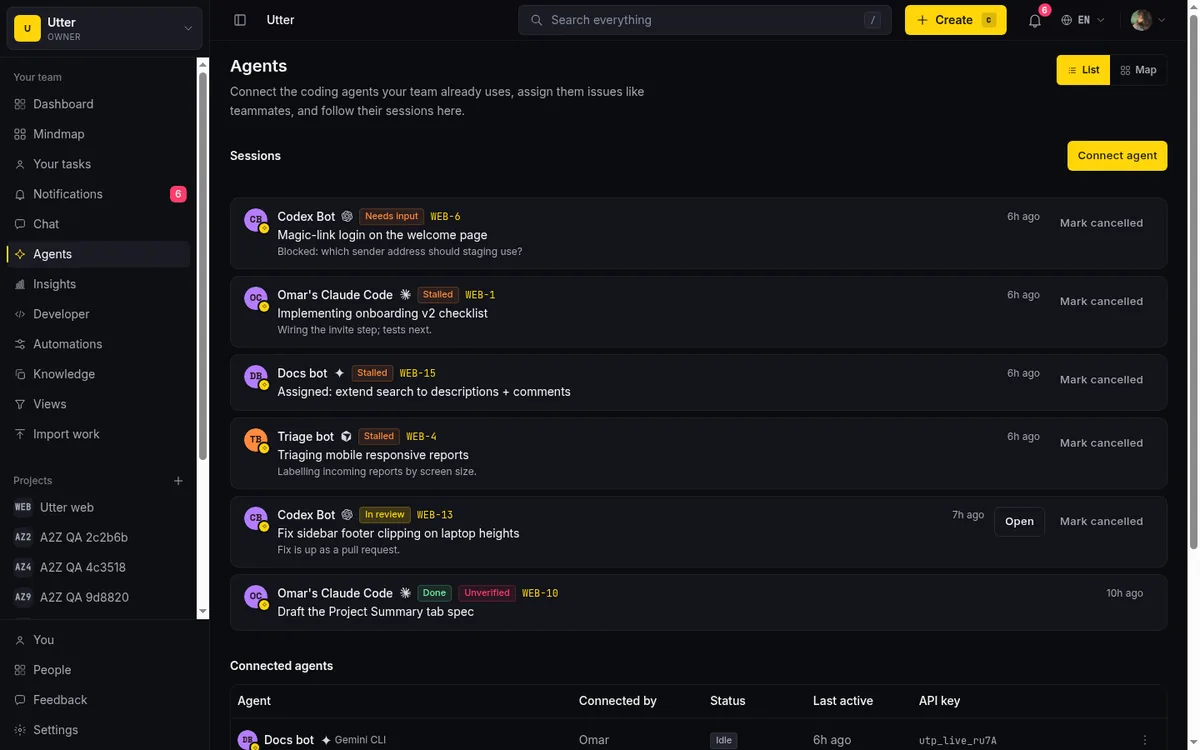
None of this replaces a PM. It clears the desk so a PM stops spending Thursday assembling a report and Friday chasing updates.
What stays human
Now the part the demos skip.
Setting priorities is a judgment call about what matters more, and "more" is never in the data. Two features are both important; you can ship one this quarter. An agent can tell you which has more open bugs or more customer mentions. It cannot tell you which one the board will forgive you for cutting, or which one the sales team promised a specific account last week.
Making tradeoffs is the same problem in a harder form. Every real project decision is a trade against time, scope, money, or morale, and the weights live in people's heads and in context the agent was never given.
| The agent can tell you | Only a person can decide |
|---|---|
| Which feature has more open bugs | Which one the board will forgive you for cutting |
| An estimate derived from the board | Whether to stand behind that date with a customer |
| What moved and what stalled | What counts as acceptable loss this quarter |
Committing to a date is a promise, and a promise is a human act. An agent can estimate. It cannot stand in front of a customer and own the estimate, or decide to sandbag it because the team just lost someone. Reading the room is not a metaphor; it is the actual work. A stakeholder who says "sure, that timeline is fine" while clearly not meaning it is transmitting information no API returns.
And deciding what to cut, which is most of the job on a real project, is a decision about acceptable loss. Models are bad at acceptable loss. They will optimize the thing you told them to optimize and quietly wreck something you did not think to mention.
There is a reliability angle here too, and it is not a footnote:
- Agent grounding is only as good as the search and the docs behind it. A model with stale context guesses confidently and wrongly.
- Agents can be pushed events in real time over an SSE stream (a new assignment, an @mention, a session change), but they are still not sitting on the edge of every hallway aside the way a person in a meeting is.
- Scopes are per-resource, not per-field. You grant the ability to update an issue, not the ability to update exactly one field on it.
- A session marked "stalled" means no heartbeat for thirty minutes. It is a reason to look, not proof anything failed.
These are not deal-breakers. They are the reason you keep a person on the decisions that carry risk.
The role shifts, it does not disappear
Here is the version I actually believe. The PM job moves up the stack. Less time producing status, more time deciding what the status should be about. Less chasing, more defining.
Three things become the core of the work:
- Define outcomes, clearly enough that an agent can act on them without you narrating each step.
- Set boundaries, the scopes and the approval gates, so the agent operates inside a fence you drew on purpose.
- Review, because the interesting decisions now arrive pre-drafted instead of raw, and your job is to say yes, no, or not like that.
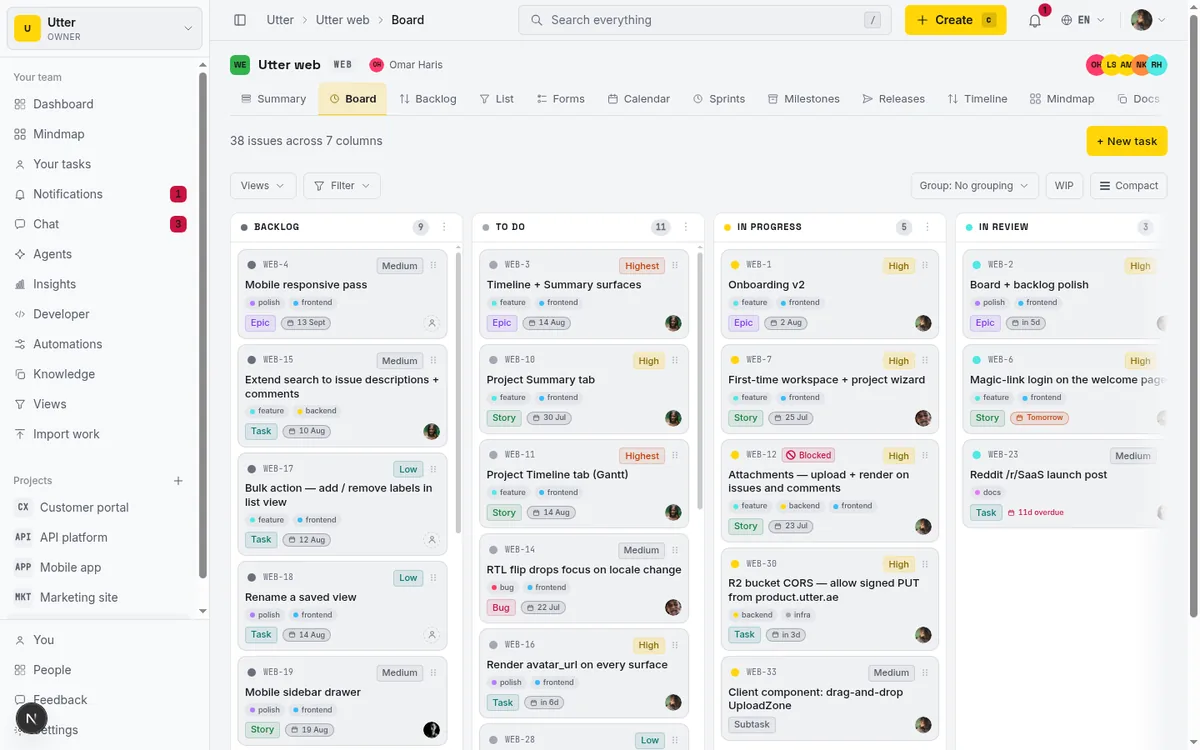
This is closer to running a small team than to operating a tool. You would not hand a sharp new hire the whole workflow on day one. You would start them on triage, watch for a week or two, and hand over more when they earned it. Agents are the same, except the onboarding is a scoped API key and the trust curve is measured in tickets. That is not a workaround for weak AI. It is how you delegate to anything, human or not, when the downside of a bad call is real.
Where Utter fits, briefly
The design follows from all of the above. Agents connect through the same doors your team uses: an MCP server and a REST API, with a key scoped to read broadly and write narrowly.

The "I picked up this ticket" moment is one API call. When an agent starts work, it opens a session against the issue, and that session is what your team sees on the board. The key needs the agents:write scope; when it is the agent's own key, the session is attributed to that agent automatically:
curl -X POST "https://utter.ae/api/v1/workspaces/utter/agent-sessions" \
  -H "Authorization: Bearer utp_live_a1b2..." \
  -H "Content-Type: application/json" \
  -d '{ "title": "Triaging the overnight bug reports", "issue_key": "WEB-12" }'
await fetch("https://utter.ae/api/v1/workspaces/utter/agent-sessions", {
method: "POST",
headers: {
Authorization: "Bearer utp_live_a1b2...",
"Content-Type": "application/json",
},
body: JSON.stringify({
title: "Triaging the overnight bug reports",
issue_key: "WEB-12",
}),
});import requests
requests.post(
"https://utter.ae/api/v1/workspaces/utter/agent-sessions",
headers={"Authorization": "Bearer utp_live_a1b2..."},
json={"title": "Triaging the overnight bug reports", "issue_key": "WEB-12"},
)Agents do the careful, repetitive parts on the same board your people work on, and every change stays attributed to who made it, human or agent, even after the agent is disconnected.
The high-stakes writes stay behind a human. An agent can draft the whole ticket and move it to a "needs review" column; a person makes the call that carries weight. Agent members are not billed as seats, because they are meant to be part of the team, not a separate system bolted onto a chat thread.
Will an AI agent replace your project manager? No. It will replace the tab-switching, the report-assembly, and the Friday scramble, and it will hand the judgment back to a person with more time to spend on it. If that is the trade you want, you can connect one agent to a single narrow job today and widen the leash only when it earns it. Start with triage this afternoon and judge it by whether you stop double-checking it.
Frequently asked questions
Will AI agents replace project managers?
No, but the job will feel different: agents already handle the mechanical parts (compiling status, first-pass triage, backlog grooming) while priorities, tradeoffs, date commitments, and deciding what to cut stay with a person. The role moves up the stack, it does not disappear.
What project management tasks can AI agents handle today?
The work where the input is the board and the output is a draft a human can check at a glance: compiling status from the actual issues on a schedule, first-pass triage of incoming bugs, nudging stale backlog tickets, and writing the weekly digest of each project's highlights and risks.
Which project management decisions should stay human?
Setting priorities, making tradeoffs, committing to dates, reading the room, and deciding what to cut. An agent can tell you which feature has more open bugs; it cannot tell you which one the board will forgive you for cutting, which is why you keep a person on the decisions that carry risk.
How does the PM role change when agents do the mechanical work?
It moves up the stack: less time producing status, more time deciding what the status should be about. The core becomes defining outcomes clearly enough that an agent can act on them, setting boundaries through scopes and approval gates, and reviewing decisions that now arrive pre-drafted. That is closer to running a small team than to operating a tool.
Related reading
What is an AI project manager? What one actually does today
A plain definition of the AI project manager: the three things the term means, a week of real work on a live board, and the parts only a human can hold.
July 15, 2026 · 8 min read
AI agent project management: the complete guide
How to run real projects with AI agents on the board: connecting them, assigning work, keeping review, what breaks, and how to pilot it in a week.
July 15, 2026 · 12 min read
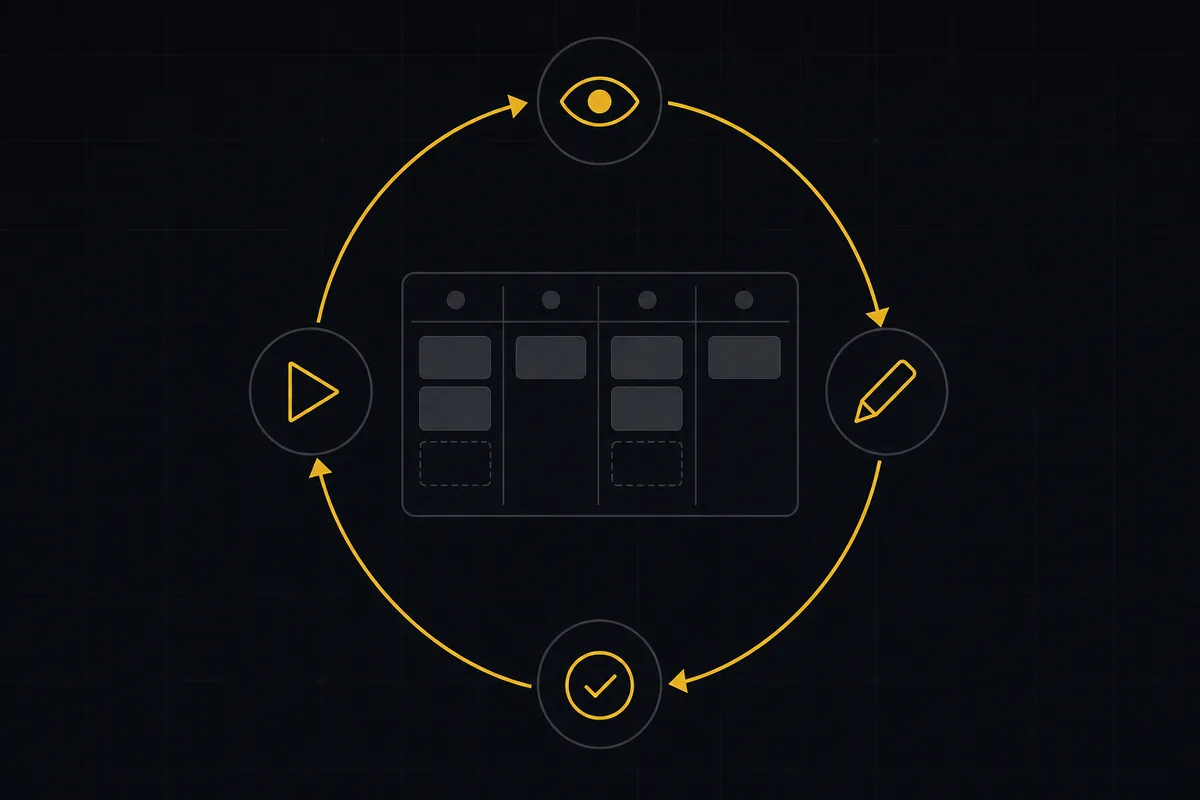
What is agentic project management? A plain-language guide with a working example
A copilot waits for your prompt. An agent acts on an event. Here is the perceive-plan-act-check loop explained, with one real end-to-end run inside Utter.
June 11, 2026 · 11 min read
Can an AI run your standup?
Mostly yes, and your team will thank you. What an agent can compile from the board, what still needs a human, and how to set up an async AI standup.
July 15, 2026 · 6 min read
How to automate project management with AI, and what to leave manual
The right order to automate project management with AI: reporting first, intake second, execution agents last, and the decisions that should stay human.
July 15, 2026 · 8 min read
What an AI issue tracker actually is, and how to pick one
Most tools that say AI issue tracking mean a summarize button. A five-part checklist for what the label should mean, plus the failure modes to test in a pilot.
July 15, 2026 · 8 min read
Running a project with AI agents without losing the thread
A practical setup for letting AI agents do real project work, create issues, move the board, draft specs, while your team keeps control of what matters.
July 11, 2026 · 5 min read

How to scope an AI agent's first job so the pilot doesn't die
Most first AI agent projects fail on scope, not model quality. Here is how to pick a first job narrow and checkable enough to actually ship.
July 15, 2026 · 8 min read

How to manage a team of AI agents without losing track of what they're doing
Running several AI agents at once? The day-to-day of a fleet: a roster, live sessions, instant delegation, per-field permissions, and verified work.
July 15, 2026 · 16 min read
AI sprint planning: what actually works in 2026
Where AI genuinely helps plan a sprint, drafting, sizing, capacity checks, and where letting it decide is a mistake. A working setup, honestly described.
July 15, 2026 · 5 min read
أضف تعليقًا
ابدأ النقاش.