
What is an AI project manager? What one actually does today
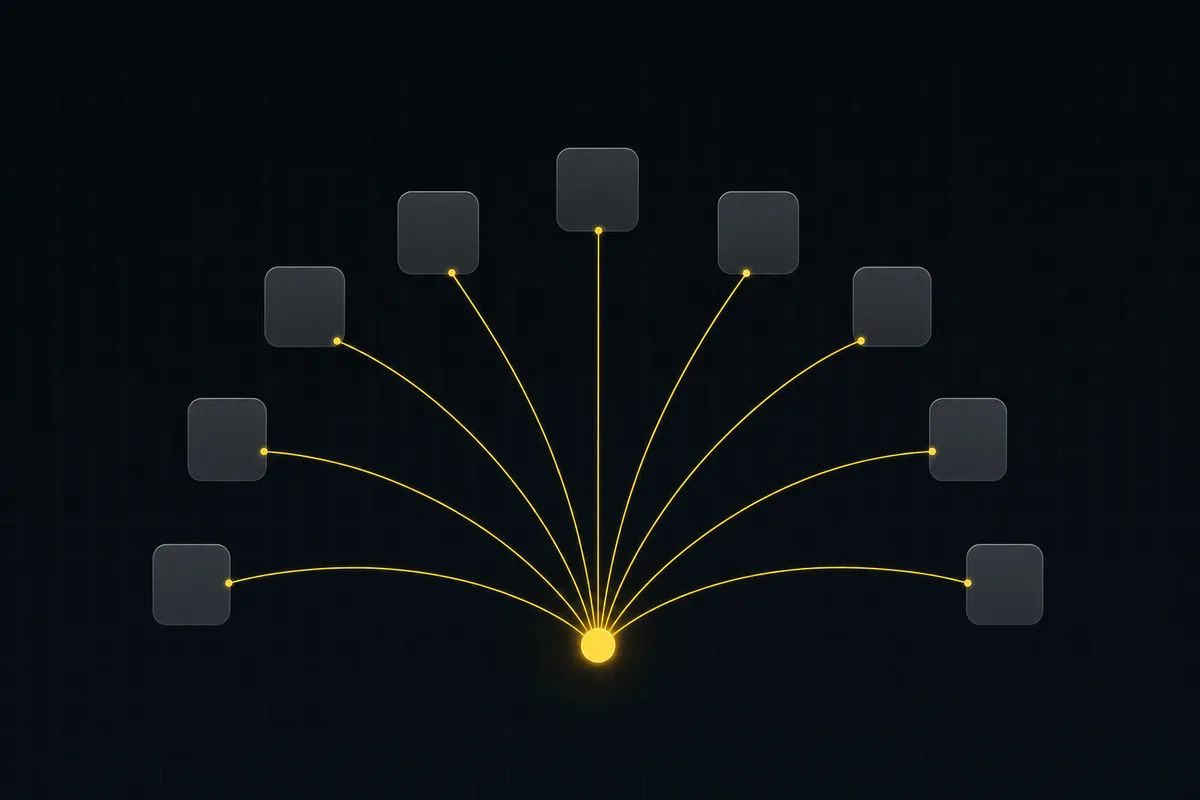
An AI project manager is software, usually an AI agent connected to your project tracker, that does the mechanical parts of a project manager's job: compiling status, triaging incoming work, chasing updates, and flagging risks. It works from the live state of the board, not from meetings, and it leaves the judgment calls to a person.
That is the whole definition. The rest of this post is what those two sentences mean in practice: the three different products currently sold under the name, a normal week of work for a real one, and the point where the job stops being something software can hold.
One thing this post is not: the argument over whether these agents will replace human project managers. We wrote that separately in will AI agents replace project managers?, and the short version is no. This piece is just the definition, because "AI project manager" has quietly become three products wearing one name, and it matters which one you are buying.
The three things people mean by "AI project manager"
| Meaning | What you actually get | Ships today | Who does the work |
|---|---|---|---|
| AI features in a tracker | Summarize and draft buttons | Yes, everywhere | You, one click at a time |
| An agent doing PM chores | Triage, standups, digests, chasing | Yes | The agent, with a person checking |
| An autonomous PM | Roadmap, deadlines, stakeholders | No | Nobody, it does not exist |
Meaning one: AI features inside a project management tool. A summarize button on a long ticket. A prompt that drafts a description. Autocomplete for acceptance criteria. This is the most common thing shipping under the label, and it is fine, but it is not a manager of anything. It is a writing aid that lives in a tracker. You still do the reading, the routing, and the chasing yourself, one click at a time.
Meaning two: an agent that does PM chores end to end on the tracker. Not a button you press, a worker that runs. It watches intake and triages new issues as they arrive. It compiles the standup from what actually changed on the board. It writes the weekly update without being asked. It has a name, an audit trail, and a scope you set on purpose. This exists today, and it is what the rest of this post describes.
Meaning three: the autonomous PM that runs the whole project. Sets the roadmap, negotiates the deadline, decides what to cut when the quarter tightens, manages the stakeholder who is quietly furious. This does not exist. Vendors gesture at it in launch videos; nobody runs a real project on it. And the gap between meaning two and meaning three is not one model release wide, because most of what is missing is not intelligence. It is accountability, which we will get to.
When a landing page says "AI project manager," it is usually selling meaning one while letting you imagine meaning three. Meaning two is the real, useful thing in the middle, and it is the concrete version of what people have started calling agentic project management: agents working inside the tracker as team members rather than as a chat window bolted to the side of it.
A week with an AI project manager
Definitions are cheap, so here is what one actually does on a live board. This is the shape of a normal week for an agent doing PM work on Utter. We build Utter, so this is the version we can vouch for, but the pattern transfers to any tracker an agent can read and write.

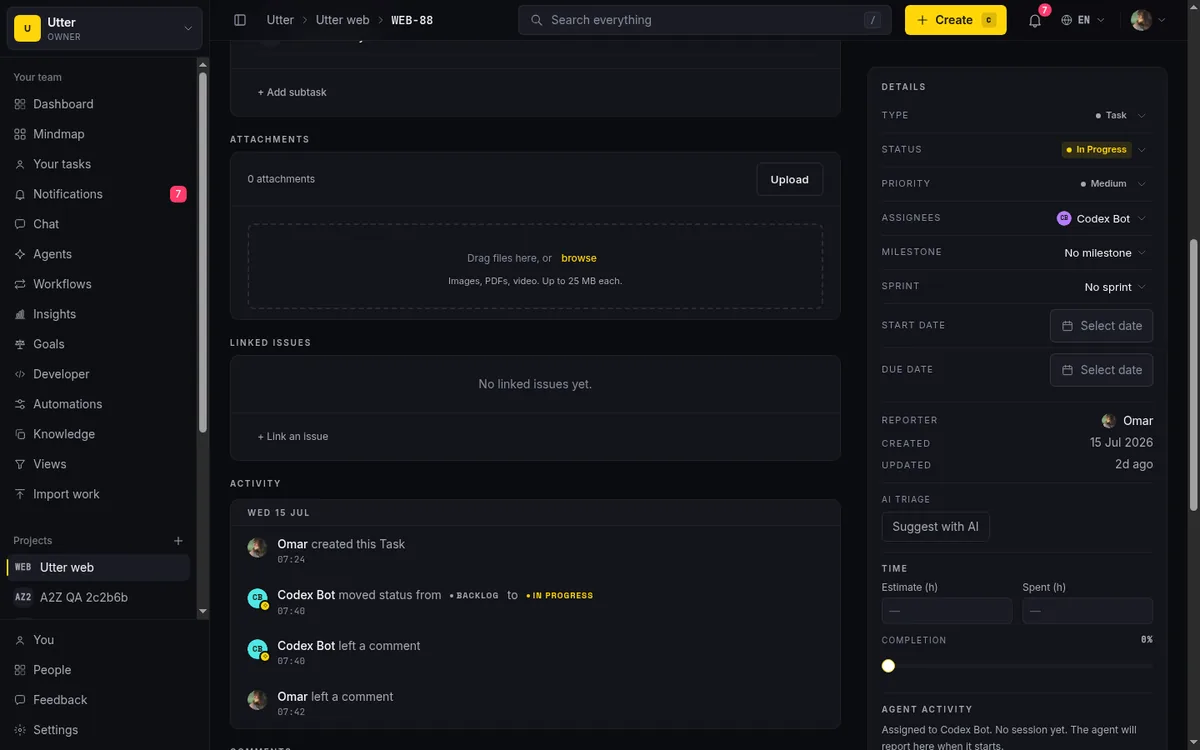
Monday, 8:00. The agent compiles the async standup from Friday's and the weekend's board activity: which issues changed column, which got comments, which pull requests landed, which agent sessions finished or stalled overnight. It posts the digest before anyone reaches a desk. Nobody recites anything from memory; the team reads for two minutes and spends its talking time on the one item that needs an argument. What this replaces, and the part of the standup you should keep, is in can an AI run your standup?
All week, as intake arrives. A bug report lands Tuesday at 14:40. The agent reads it, checks for duplicates, classifies it as a bug, sets a priority from the severity signals in the text, applies labels, and routes it to the right project. A feature request lands Thursday and gets the same treatment without the urgency.
flowchart LR
    A[New issue arrives] --> B[Agent reads it]
    B --> C{Duplicate?}
    C -->|Yes| D[Link and close]
    C -->|No| E[Classify and prioritize]
    E --> F[Label and route]
    F --> G[Human spot check]
This is first-pass triage, and the win is not that the agent judges better than the person who used to do it. The win is that it happens within a minute of arrival instead of at Friday grooming, so the board reflects reality all week instead of one afternoon in five.
Wednesday, mid-morning. The agent flags what the data shows. Two issues have sat in the review column for four days with no reviewer activity. One engineer is carrying six in-progress issues while the rest of the team averages two. It leaves a comment on each stalled ticket asking for a state update, which is the chasing part of the job nobody will miss, and it posts the workload imbalance as an observation with links, not a verdict. Whether the reviewer is on leave or the six issues are all trivial is context the agent does not have. Its job is to make a human look today instead of discovering the pile-up at the sprint review.
That chasing comment is not magic. On Utter it is one call to the public API:
curl -X POST "https://utter.ae/api/v1/workspaces/utter/projects/WEB/issues/WEB-42/comments" \
  -H "Authorization: Bearer utp_live_a1b2..." \
  -H "Content-Type: application/json" \
  -d '{"body_md": "This has sat in review for 4 days with no reviewer activity. Still current, or should it move back?"}'
await fetch(
"https://utter.ae/api/v1/workspaces/utter/projects/WEB/issues/WEB-42/comments",
{
method: "POST",
headers: {
Authorization: "Bearer utp_live_a1b2...",
"Content-Type": "application/json",
},
body: JSON.stringify({
body_md:
"This has sat in review for 4 days with no reviewer activity. Still current, or should it move back?",
}),
},
);import requests
requests.post(
"https://utter.ae/api/v1/workspaces/utter/projects/WEB/issues/WEB-42/comments",
headers={"Authorization": "Bearer utp_live_a1b2..."},
json={
"body_md": "This has sat in review for 4 days with no reviewer "
"activity. Still current, or should it move back?"
},
)Friday, end of day. The agent writes the weekly digest: what shipped, what moved, what stalled, and what looks at risk for the sprint goal, drawn from the full week of activity rather than whatever people remember at 16:50. It goes to the stakeholders who will never open the board. We wrote up the mechanics in let AI write your weekly project update.
Notice what is missing from that week: a decision. The agent compiled, filed, chased, and flagged. Every call that could hurt someone went to a person with the context to make it. That split is not a limitation we are apologizing for. It is the design.
flowchart TD
    W[Work the project generates] --> Q{Mechanical or judgment call}
    Q -->|Mechanical| A[Agent compiles, triages, chases, flags]
    Q -->|Judgment| H[Human decides scope, dates, promises]
    A --> R[Person spot checks the output]
The inputs matter just as much. Everything above works because the source of truth is the board, not a meeting transcript. An agent that reads meetings inherits the accuracy of meetings. An agent that reads the tracker inherits the accuracy of the tracker, which is why most of the setup effort is board hygiene: statuses that mean what they say, a blocked column that actually means blocked, review columns with transition rules so work cannot skip the gate quietly.
What an AI project manager cannot do
This is the part the marketing mumbles.
It cannot trade scope against a deadline. That decision requires knowing what the company promised, to whom, and what breaking each promise costs. None of that lives on the board.
It cannot negotiate with a stakeholder. Negotiation is mostly hearing what the other person is not saying, and an agent's entire worldview is what got written down.
It cannot own a commitment. An agent can produce an estimate. It cannot promise a date, because a promise is only worth the consequences the promiser can suffer, and an agent suffers none.
It cannot read a room. A sponsor who says "fine, ship it" in a flat voice is transmitting information that never reaches an API.
And it cannot be accountable when something ships broken. Someone has to sit in the incident review and say "that was my call." Put an agent in that seat and you have built a system where nobody made the call, which is worse than a wrong call. This is why teams that run agents well write down which decisions an agent may take alone and which need a person. Accountability does not transfer to something that cannot be fired or promoted, no matter how good the model gets.
So when a product page says its AI "manages your project," translate it: it compiles and files, tirelessly. That is worth real money. It is not management.
What this changes for the human PM
The short version, since we argue the long one in the replacement post: the mechanical half of the job shrinks toward zero and the judgment half grows to fill the space. Less Thursday spent assembling the report, more time deciding what the report should change. The people who lose in this shift are the ones whose entire output was the compilation. The ones who win are the ones who were always short on time to think, which in our experience is most of them.
How to try one this week
You do not need a rollout plan. You need one narrow chore and a way to check the work.
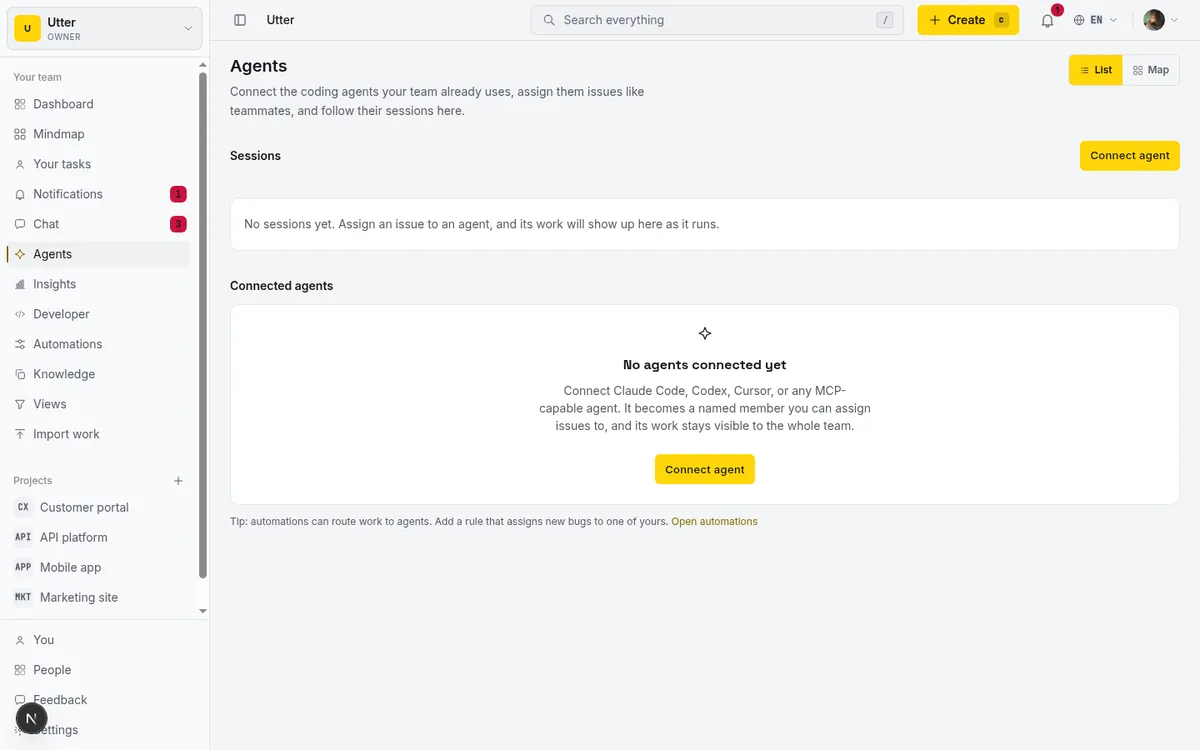
Disclosure, since we have opinions and a product in the same paragraph: we make Utter, a tracker built so agents work in it as named team members. An agent gets a profile, live sessions that show its state on the ticket, a per-agent audit trail of every change it makes, and an API key scoped to exactly what it should touch. It connects over MCP or the REST API. Agents are never billed as seats; the pricing is a free plan and Pro at $3 per builder per month, with viewers free and uncapped.
The one-week version looks like this:
- Turn on AI triage for a single project and spot-check every decision it makes.
- If by Friday you have stopped checking, add the Monday standup digest.
- If the standup earns its keep, add the Friday update.
Each step retires a chore, and at no point have you handed anything irreversible to software.
That is what an AI project manager is in 2026: not a replacement in a suit, a fast colleague for the boring half of the job. If you want to see one on a real board, start with the AI tools in Utter and give it your intake queue first.
Frequently asked questions
What is an AI project manager?
An AI project manager is software, typically an AI agent connected to your project tracker, that handles the mechanical parts of the job: compiling status, triaging new issues, chasing stale work, and flagging risks. It reads the live state of the board instead of sitting in meetings, and it leaves decisions to people.
Can an AI project manager replace a human project manager?
No. It removes the compiling and chasing work, but tradeoffs, commitments, and accountability stay with a person. The full argument is in will AI agents replace project managers?
What does an AI project manager cost?
Mostly the model usage, billed as AI credits or tokens, plus whatever your tracker charges. On Utter agents never take a paid seat: plans are free or $3 per builder per month, and you pay only for the AI work the agent actually does.
How do I set one up?
Give an agent a scoped API key to your tracker and one narrow chore, like triage; the AI agent project management guide walks through the whole setup.
Related reading

Will AI agents replace project managers? What actually changes
Agents already handle the mechanical parts of project management. The judgment part is harder, and it is not going anywhere. An honest look at the shift.
July 15, 2026 · 7 min read
AI agent project management: the complete guide
How to run real projects with AI agents on the board: connecting them, assigning work, keeping review, what breaks, and how to pilot it in a week.
July 15, 2026 · 12 min read
Can an AI run your standup?
Mostly yes, and your team will thank you. What an agent can compile from the board, what still needs a human, and how to set up an async AI standup.
July 15, 2026 · 6 min read
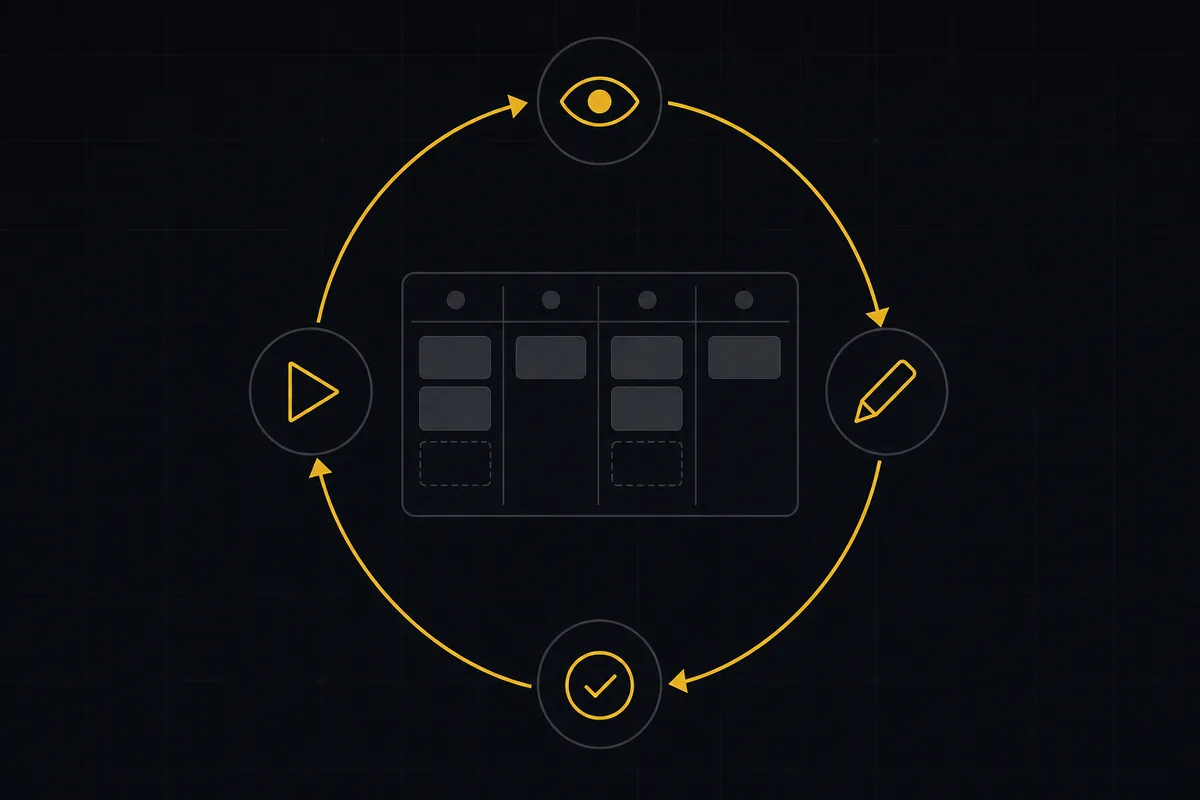
What is agentic project management? A plain-language guide with a working example
A copilot waits for your prompt. An agent acts on an event. Here is the perceive-plan-act-check loop explained, with one real end-to-end run inside Utter.
June 11, 2026 · 11 min read

What an AI issue tracker actually is, and how to pick one
Most tools that say AI issue tracking mean a summarize button. A five-part checklist for what the label should mean, plus the failure modes to test in a pilot.
July 15, 2026 · 8 min read

How to automate project management with AI, and what to leave manual
The right order to automate project management with AI: reporting first, intake second, execution agents last, and the decisions that should stay human.
July 15, 2026 · 8 min read
The best AI project management software in 2026, honestly ranked
Eight AI project management tools ranked with a stated lens: what the AI really does, what it costs on top of the seat price, and who each one fits.
July 15, 2026 · 10 min read
Stop chasing status updates: let AI write the weekly project digest
How to automate a weekly status report with AI that reads what actually moved and what stalled, instead of a dumb scheduled dump of ticket counts.
June 1, 2026 · 7 min read
Running a project with AI agents without losing the thread
A practical setup for letting AI agents do real project work, create issues, move the board, draft specs, while your team keeps control of what matters.
July 11, 2026 · 5 min read

How to manage a team of AI agents without losing track of what they're doing
Running several AI agents at once? The day-to-day of a fleet: a roster, live sessions, instant delegation, per-field permissions, and verified work.
July 15, 2026 · 16 min read
أضف تعليقًا
ابدأ النقاش.